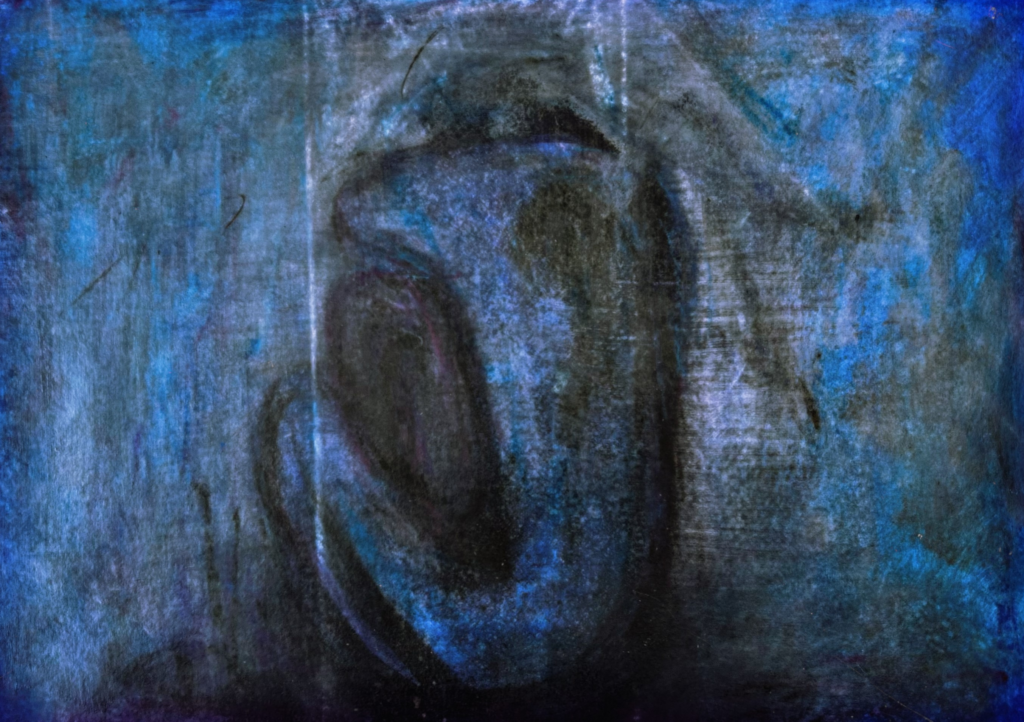
You have before you, an image. You inherit the image already tired.
It’s been copied, dragged, compressed, screen-grabbed, renamed badly, misfiled. Hito Steyerl would call it poor, but perhaps that term of phrase is word is misleading. It’s not lacking – It’s loaded. This image has been places. It’s been mishandled. It remembers.
You start again.
You paint it. Tear it up. Paint it again. Draw over it. Erase it. Scan it. Digitise it. Manipulate it. Pull it into 3D. Stage it under fake lights in Blender. Create a looping film. Databend that film, corrupt the metadata with sentiment. Take some stills. Flatten them. Collage it digitally. Print it. Cut it out. Collage it physically. Scan it again. Digitise it again. Make a film. Cook the toast, butter the toast, eat the toast, shit the toast, need the toast, cook the toast, eat the toast.
Something is always lost. Something else is always gained.
 THE FAUX SAVANT:
Resolution drops, adaptability increases.
File formats are post-modern costuming.
Everything survives by translation. You’ll figure it out, just keeping playing with all your little toys and gadgets.
What about the rich image? Not as in the pristine object, the stable, finished thing. Images processed and worked with repeatedly also accumulate meaning which is more representative of contemporary existence. New histories, at once failing to deliver promises and offering new perspectives.
You can see bodies as files. Files as bodies. It is Atkins’ almost comically uncanny performances of consciousness through distorted, poor or mis-representative digital models on in internal stage, projected. Affect leaking through compression artefacts. Sincerity surviving render pipelines. The work persists, and you consider how work in these loops can truly be accredited as work, labour.
THE ECHO:
You’ve been here before.
You will be here again.
This version remembers bits of the last version, and it’s only a matter of time they piece it together again [Piece it together again].
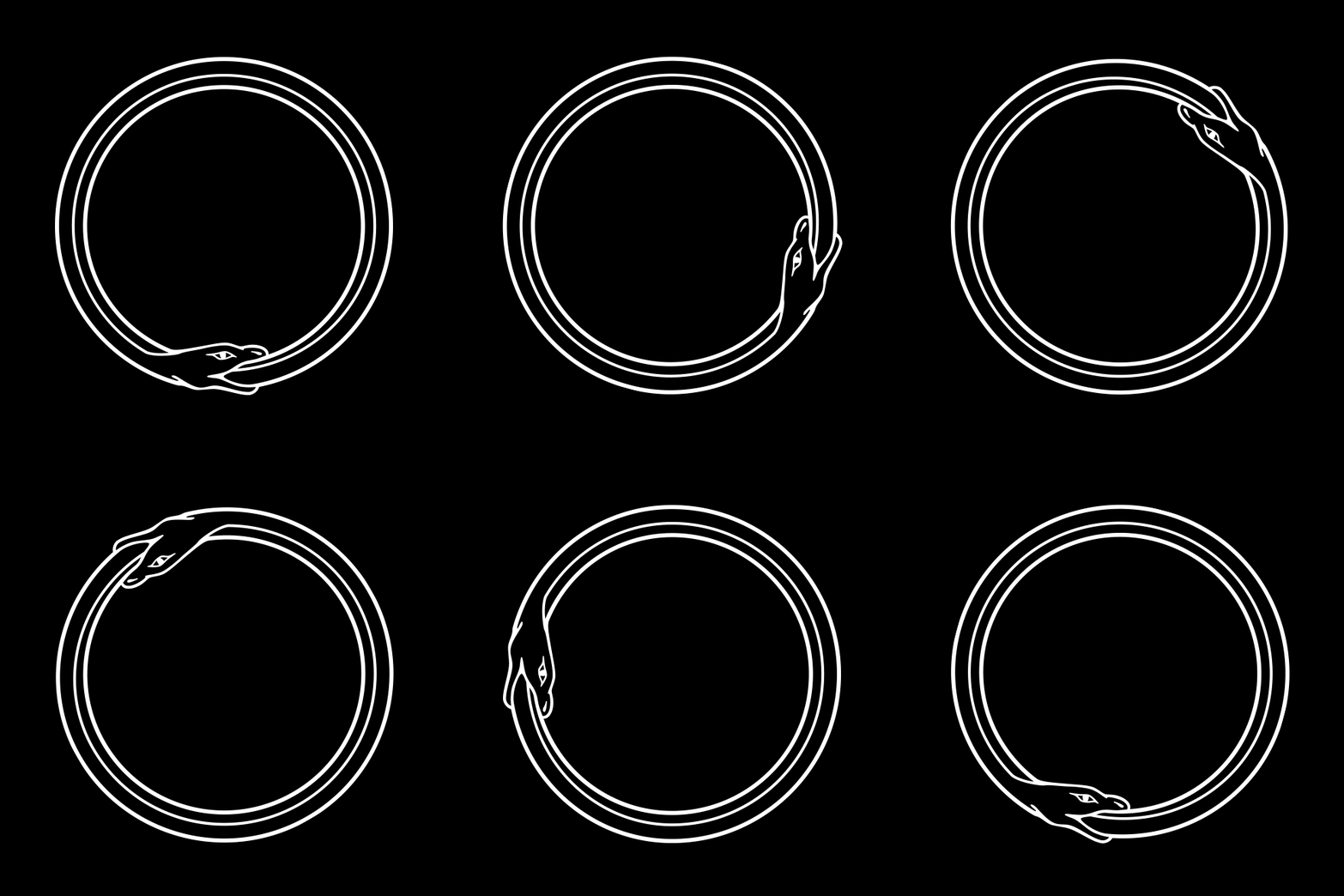
The loop shrinks and tightens each time it eats itself. Have you noticed a recent increase in contemporary references to the Ouroboros? Each iteration refers back to the last. Process eats product. The image becomes a record of its own becoming – a strange loop, self-referential, recursive,
THE CARTOGRAPHER:
Consciousness is not located anywhere; it is the
process of a system modeling itself modeling itself.
Without intervention, it could continue forever.
And part of you wants that.
Loopedy-looing all over the place is in your nature. Stopping feels arbitrary and allows the physical body to catch up, powering down your heart or energy core or whatever it is you have.
THE GRIP:
Enough.
Choose.
End it or just admit you won’t ever end it.
Ending the loop takes will. A grip of yourself. Closure is an act of violence. Stand back and look at the composition of the work, let it breathe and recover.
Then get in there, cut open the patient and stick your head in there. You hex-edit the file. You insert poetry into metadata. Stream-of-consciousness buried in headers no one reads. Human affect smuggled into cold technological structures and systems. The machine carries your breath without knowing it.
THE FAUX SAVANT:
Metadata isn’t neutral.
It’s just text pretending to be invisible.
Make sure you focus mostly on the central 30%-80% of the metadata to manipulate or infiltrate, replace entire selections of single characters, do not touch the header or the footer actually, don’t listen to this guy. It will corrupt the image beyond system comprehension and display.
The image leaves you both poor and rich.
Poor in resolution.
Rich in crossings.
Degraded but expansive.
Unstable, but alive.
What’s lost is purity.
What’s gained is history.
And you realise the image isn’t finished – it’s just stopped.